Margaret Jane Piatos

The Duterte ICC Case Could Define the Future of International Accountability

Photo © ICC-CPI. Used with permission.

By: Margaret Jane Piatos

When the International Criminal Court (ICC) issued a warrant for former Philippine President Rodrigo Duterte and later confirmed his continued detention in March 2026, the moment marked far more than the legal downfall of a controversial leader. It has become one of the most consequential tests of international criminal law in decades. At stake is whether global legal institutions can meaningfully hold powerful national leaders accountable for widespread human rights violations. Ultimately, the manner in which the case is determined will set a critical precedent for holding past, current, and future national leaders accountable for large-scale human rights violations.

Duterte’s anti-drug campaign, “war on drugs,” launched immediately after he took office on June 30, 2016. Framed as a public safety initiative to eliminate narcotics and restore order, the campaign authorized aggressive police operations and killings aimed at eliminating drug dealers and users. Duterte frequently portrayed the drug trade as an existential threat to Philippine society and promised to eradicate it through force. 

The campaign quickly turned deadly. Philippine government data recorded more than 6,000 deaths connected to anti-drug operations while Duterte was in office. Human rights organizations estimate the real number is likely far higher at more than 12,000 deaths, many of them among the country’s urban poor. At least 2,555 killings were attributed directly to the Philippine National Police, while thousands more were carried out by unidentified gunmen widely believed to be connected to security forces. 

For critics, the pattern suggested something more than isolated abuses. The ICC alleges that Duterte is responsible for crimes against humanity of murder and attempted murder under Article 7(1)(a) of the Rome Statute, committed as part of a “widespread and systematic attack against a civilian population,” between 2011 and 2019. The investigation covers not only his presidency but also his earlier tenure as mayor of Davao City, where he ruled for more than two decades.

Duterte never hid his willingness to use violence as a crime-fighting strategy. On the eve of his presidential victory in 2016, he told a crowd of supporters: 

“Forget the laws on human rights. If I make it to the presidential palace, I will do just what I did as mayor. You drug pushers, hold-up men and do-nothings, you better go out. Because I'd kill you,” he said at his final campaign rally. 

“I'll dump all of you into Manila Bay, and fatten all the fish there.”

During a 2024 Philippine Senate inquiry into the drug war, Duterte offered what he called “no apologies, no excuses” for the campaign and took responsibility for the killings carried out during his presidency. He also admitted to employing a small death squad during his time as mayor of Davao.

Yet Duterte continues to maintain powerful support. Philippine politics is characterized less by rigid ideological parties as we see in the United States, and more by coalitions built around prominent political clans and regional alliances. Duterte rose to power as a populist outsider from Mindanao, the second largest island in the Philippines, positioning himself as a tough alternative against the traditional political establishment in Manila. Many supporters credit him with restoring order and confronting criminal networks that previous administrations failed to control. 

This enduring domestic support illustrates one of the central tensions in the ICC case. For families of victims, the investigation represents a rare opportunity for justice. For Duterte’s supporters, the prosecution is viewed as international interference in Philippine sovereignty. 

The legal battle is now firmly underway. Duterte was surrendered to the ICC in March 2025 after a secret arrest warrant was issued and later made public. His initial appearance before the Court took place shortly after, and the confirmation of charges hearing was held in February 2026. On March 6, 2026, the ICC Appeals Chamber rejected Duterte’s appeal challenging the review of his detention and confirmed that he would remain in custody while proceedings continue. 

Beyond the Philippines, the case's implications extend to the broader international system. In recent years, several governments have adopted aggressive security policies to combat crime and terrorism. Countries such as El Salvador, where President Nayib Bukele has implemented emergency powers and mass arrests to crack down on gangs, and India, where counterterrorism laws have expanded state surveillance, illustrate how governments are increasingly relying on strong executive authority in the name of public safety. These policies often expand executive power and weaken procedural safeguards. If the ICC successfully prosecutes a former head of state for crimes against humanity, it would reinforce the principle that national leaders cannot hide behind sovereignty when large-scale abuses occur. If it fails to do so, the credibility of international accountability mechanisms is likely to weaken. 

Ultimately, the significance of the Duterte investigation lies not only in what it says about the Philippines but also in what it signals to leaders around the world. 

Artificial Intelligence Is the 21st Century’s Nuclear Weapon

By: Margaret Jane Piatos

American companies have spent $335 billion and counting on artificial intelligence (AI) between the years 2013 and 2023, and today, 79% of Americans interact with AI several times a day. What began as a niche technological field has quickly become embedded in finance, healthcare, education, defense, and even personal decision-making. As governments and corporations race to dominate this emerging technology, the pace of development far outstrips that of regulation.

AI is as dangerous and as strategically transformative as nuclear weapons were in the 20th century, and it must be governed with the same urgency and international cooperation before competition turns into catastrophe.

In the 20th century, nuclear weapons transformed international politics almost overnight. They redefined how we fought wars, and consequently, who held hegemony. But nuclear technology also forced the world to confront a terrifying reality: innovation without restraint could mean total destruction. 

The atomic bomb dropped on Hiroshima in 1945 killed an estimated 100,000 people. Modern tactical nuclear weapons are far more powerful, and at the height of the Cold War, the global arsenal grew large enough to destroy human civilization many times over.  It took regulations such as the 1968 Nuclear Non-Proliferation Treaty, the International Atomic Energy Agency, and Cold War arms-reduction agreements like SALT and START, to stabilize the system. 

Today, artificial intelligence is advancing even faster — and with far fewer guardrails.

Unlike nuclear weapons, AI does not require rare uranium or massive reactors. However, it requires data, computing power, and engineering talent. That makes it easier to develop and more difficult to contain. Yet its strategic impact may be just as profound. AI can enhance cyberwarfare, power autonomous weapons systems, manipulate financial markets, disrupt infrastructure, and more. The state that leads in AI will not just have faster software, but it will have a structural advantage in economic productivity, military capability, and information control.

And countries know it.

The United States and China are locked in a race for AI dominance. Washington frames AI leadership as critical to national security and economic competitiveness. Although the United States still maintains a far larger nuclear arsenal with 5,277 warheads compared to China’s 600 warheads, today's balance of power may not be determined by stockpile size alone. 

Beijing has openly declared its ambition to become the world leader in AI, embedding AI development into its long-term industrial planning and military modernization strategy. In some areas, particularly the integration of AI into surveillance systems and military deployments, China may be moving faster and with greater coordination than Western approaches. 

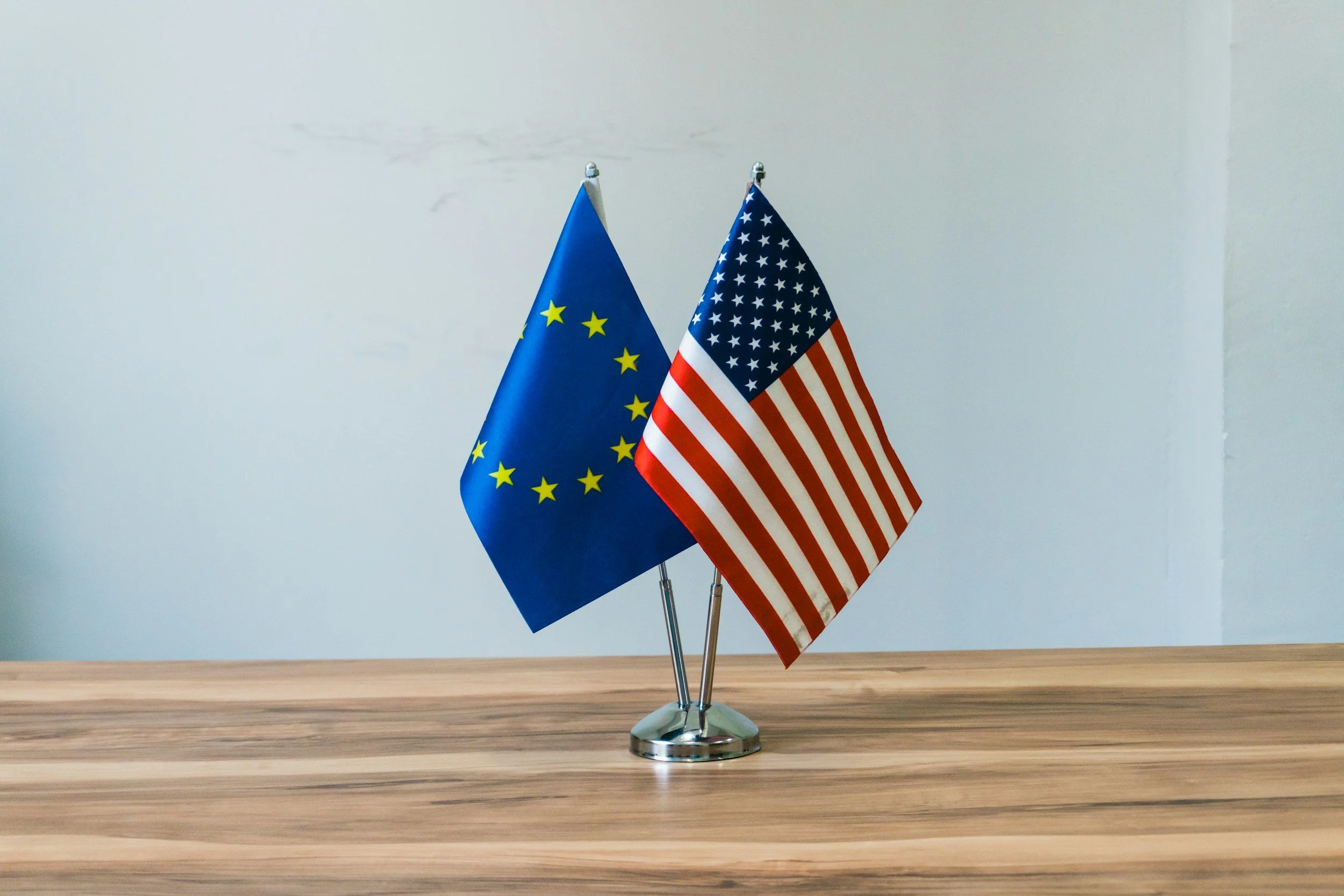
The European Union, meanwhile, is racing to shape regulatory standards that could define global norms. Through its landmark AI Act, the EU has moved to classify AI systems by risk level, impose strict transparency requirements on high-risk applications, and ban certain uses such as social scoring and some forms of biometric surveillance. By prioritizing safety and human oversight, the EU is attempting to export its regulatory model beyond Europe’s borders. If successful, the EU could set the rules of the road for AI governance worldwide, not by dominating innovation, but by defining the standards companies must meet to access one of the world’s largest markets. 

This competition resembles the early years of the arms race, but with one critical difference: AI development is primarily driven by private companies operating across borders. Governments are competing not only with rivals abroad but also, motivated by President Trump’s AI challenge, racing to outpace domestic innovation. 

That dynamic creates a dangerous incentive structure. When speed becomes the priority, safety becomes secondary. The result is an emerging AI arms race without clear rules or shared red lines.

The risks are not hypothetical. Autonomous weapons systems could make battlefield decisions faster than human oversight allows. AI-generated misinformation could undermine public trust in democratic institutions. Advanced cyber capabilities could cripple infrastructure without a single missile being launched. And as AI systems grow more complex, even their creators may struggle to predict their behavior.

Nuclear weapons taught the world a painful lesson: revolutionary technologies cannot be managed through optimism alone. Governance must evolve alongside capability. 

AI requires a similar mindset. It means establishing guardrails before chaos forces them upon us. Nations should cooperate to limit fully autonomous lethal weapons, prevent AI from controlling nuclear launch systems, and establish monitoring mechanisms for the most advanced AI models. Export controls on advanced semiconductor chips are already a step toward recognizing AI’s strategic importance, but they are only the beginning.

Some argue that AI is too embedded in civilian life and too rapidly evolving to be regulated like nuclear weapons. They are right that AI is different. But that makes regulation more urgent. And we must treat it as such, before competition becomes a catastrophe. 

Mirrored Corruption in Southeast Asia 

By: Margaret Jane Piatos

In Southeast Asia, political reform is like a game of musical chairs. In the past year alone, both the Philippines and Indonesia have faced waves of public outrage over corruption and governance failures, and each time, their leaders responded by rearranging it.

In early 2024, the Philippines was submerged: literally and politically. A massive ₱500-billion (US$10.15 billion) flood control program, designed to protect provinces from typhoon damage, became the center of a national scandal after reports revealed that much of the funding had become “ghost projects.” Entire floodwalls existed only on paper, and many communities in Pampanga and Bulacan watched their homes drown again during the rainy season. Days later, President Ferdinand Marcos Jr. announced a sweeping cabinet reshuffle, replacing several high-profile leaders in what he called a “renewal of government integrity.” But few believed that new faces meant new ethics. 

The Philippines reshaped nearly every branch of government. The Department of Public Works and Highways (DPWH) Secretary Manuel Bonoan stepped down amid investigations, replacing former Department of Transportation Secretary Vince Dizon, who swiftly demanded courtesy resignations from senior officials and filed graft complaints against implicated contractors.

The Senate, too, saw upheaval. Francis “Chiz” Escudero was ousted as Senate President, accused of delaying impeachment proceedings and linked to firms that profited from flood projects, and Vincent “Tito” Sotto III reclaimed the presidency. In the House of Representatives, Speaker Martin Romualdez, a cousin of the president, resigned following allegations of budget insertions, succeeded by Faustino “Bojie” Dy, who vowed “zero tolerance” for corruption. 

To many Filipinos, this felt more like repositioning than reform. The symbolism was clear: in a country where corruption routinely erodes public trust, reshuffling the cabinet may avoid the headlines, but it cannot rebuild the foundations of integrity. 

Across the sea, Indonesia was living through its own spectacle. In October of 2025, mass protests erupted across Jakarta, Surabaya, and Yogyakarta after police killed a motorcycle taxi driver during a labor demonstration. The protests, initially about police brutality, soon grew into a broader indictment of corruption and elite privilege. Lawmakers’ generous housing allowances, rising food prices, and the widening gap between politicians and citizens fueled resentment. Just a week later, President Prabowo Subianto unveiled his second major cabinet reshuffle since taking office. 

Purbaya Yudhi Sadewa, former head of the Deposit Insurance Corporation, became Finance Minister. Djamari Chaniago replaced Budi Gunawan as Coordinating Minister for Political and Security Affairs. The Minister of Youth and Sports, Dito Ariotedgo, was replaced by Erick Thohir, a businessman and former Minister of State-Owned Enterprises. President Prabowo also announced a new Hajj and Umrah Ministry, expanding what he called the “Merah Putih Cabinet,” although it had the opposite effect.

Indonesians were unconvinced. For many, the reshuffle symbolized not renewal, but repetition, not addressing the public’s demands. Instead of reform, it appeared to be a disguise to project control while preserving political loyalty: the same robust networks, merely rearranged.

Both Prabowo and Marcos rely on reshuffling as a political strategy rather than a governance tool. It suggests responsiveness, even if nothing changes beneath the surface. What makes this cycle so dangerous is not merely the corruption itself, but the illusion of progress it sustains. Each reshuffle is framed as a cleansing measure, yet it reinforces the same networks of patronage and elite exchange that enabled the corruption to begin with. 

This illusion of reform carries beyond politics. Foreign and domestic confidence wavers as fiscal accountability weakens. Inequality deepens when funds intended for infrastructure or welfare are diverted into private interests. Most dangerously, public cynicism grows. The more leaders rely on reshuffles to manage outrage, the more fragile their democracies become. 

In this way, the Philippines and Indonesia are mirror images of one another: vibrant democracies on paper, but systems still driven by personal loyalty and patronage. Each government appointment rewards alliances, and each scandal threatens them. But corruption is not just tolerated; it becomes institutionalized. Until they stop playing musical chairs, every promise of reform will sound the same.